📍 Contact Us
Factory Address:
Building 8, No.2-1, Nanyi Road,
Yongshan Village, Shiji Town,
Panyu Dist., Guangzhou, China.
Yongshan Village, Shiji Town,
Panyu Dist., Guangzhou, China.


Authored by: PrintVision Business Strategy & Financial Team
The most dangerous phrase in the custom apparel business is, “I just charge what the shop down the street charges.” In the highly competitive 2026 Direct-to-Film (DTF) market, engaging in a blind price war is a race to the bottom. To scale a profitable B2B print factory, you must transition from “guesstimating” to utilizing precise, data-driven cost analytics.
You need to know the exact fraction of a cent it costs to produce every square inch of your transfers. Today, the PrintVision team provides the definitive framework for calculating your true consumable costs and optimizing your Return on Investment (ROI).
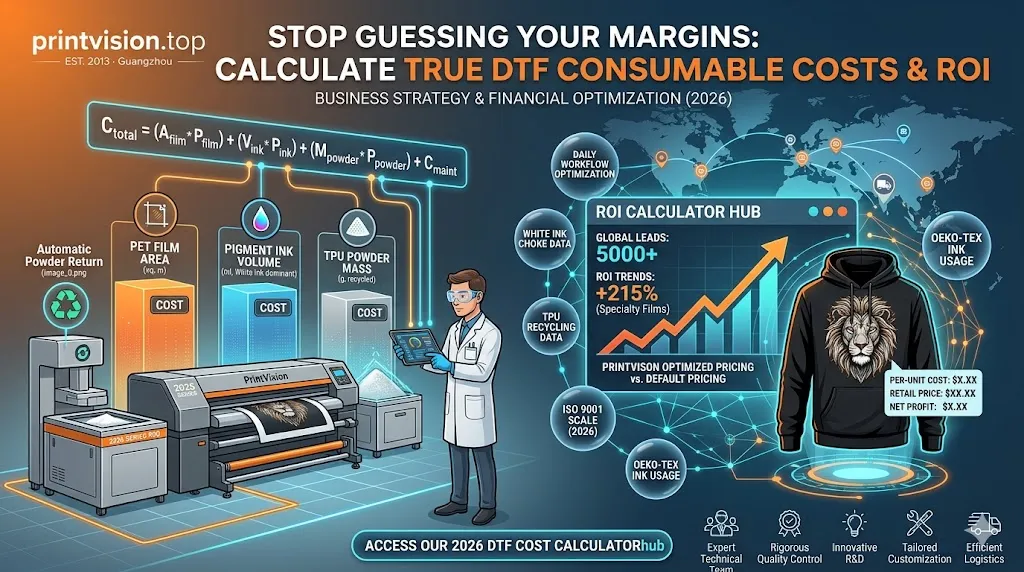
To calculate the cost of a single printed logo, you must break down the three primary consumables: PET Film, Pigment Ink, and Hot Melt TPU Powder.
Film is your canvas, and it’s calculated by area. Whether you use a PrintVision A3 Desktop System (sheet or small roll) or a 60cm Industrial Printer, the math requires calculating the exact footprint of your nested designs.
Ink is measured in milliliters (ml). In DTF, CMYK inks are relatively inexpensive. The true cost driver is the Titanium Dioxide White Ink underbase, which can account for up to 70% of your total ink cost per print.
Powder is measured in grams. The amount of powder that adheres to the wet ink depends on the design’s ink density and the efficiency of your shaker.
To standardize your pricing, you need a reliable formula. For a specific print job, the total direct consumable cost ($C_{total}$) can be calculated using the following equation:
$$C_{total} = (A_{film} \times P_{film}) + (V_{ink} \times P_{ink}) + (M_{powder} \times P_{powder}) + C_{maintenance}$$
Where:
Note: Professional RIP software like Flexi or Cadlink will provide you with the exact $V_{ink}$ for every job before you even press print.
Direct consumables are only part of the story. According to the U.S. Small Business Administration (SBA) guidelines on manufacturing pricing, failing to account for indirect overhead is why many factories struggle with cash flow.
When establishing your retail or B2B wholesale prices, you must factor in:
Once you know your exact mathematical cost ($C_{total}$), you can establish a robust Cost-Plus or Value-Based pricing strategy.
By investing in high-efficiency equipment like PrintVision’s DTF ecosystem—which actively reduces ink consumption, recycles powder, and minimizes manual labor—you lower your baseline cost. This gives you the strategic freedom to either undercut your competitors while maintaining margins, or invest that profit back into premium marketing.
Stop guessing your profits.
Visit www.printvision.top today. Contact our business consulting team to access our interactive 2026 PrintVision ROI Calculator Excel Template, designed specifically for our B2B partners.