Phone:
(701)814-6992
Physical address:
6296 Donnelly Plaza
Ratkeville, Bahamas.
Phone:
(701)814-6992
Physical address:
6296 Donnelly Plaza
Ratkeville, Bahamas.

Over the past few years, DTF printing (Direct to Film printing) has rapidly transformed the global custom printing industry. From small apparel studios to industrial-scale garment factories, DTF technology is increasingly being adopted as a flexible, cost-efficient, and scalable printing solution.
Unlike traditional printing methods that require strict material limitations or complex setups, DTF printing offers an adaptable workflow that supports a wide variety of fabrics, colors, and production volumes. This versatility has made DTF one of the fastest-growing segments in the digital textile printing market.
In this article, we will explain:
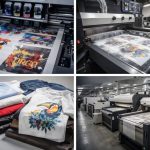
DTF (Direct to Film) printing is a digital heat-transfer printing technology that prints designs onto a special PET film, applies hot-melt adhesive powder, and then transfers the design onto fabric using a heat press.
Unlike Direct to Garment (DTG) printing, which prints directly onto fabric, DTF prints onto film first. This process allows for greater material compatibility, better color consistency, and stronger adhesion.
DTF printing can be used on:
This universal compatibility is one of the key reasons behind its rapid global adoption.
The DTF workflow consists of several clearly defined steps:
The artwork is prepared using professional RIP software such as Maintop, RIIN, or Flexi. White ink layers are generated automatically, ensuring opacity on dark fabrics.
The design is printed onto DTF PET film using a DTF printer equipped with CMYK + White ink configuration.
Hot-melt adhesive powder is evenly applied to the printed film. Industrial systems use automatic powder shakers to ensure uniform coverage and powder recycling.
The film passes through an oven or heating tunnel to melt and activate the adhesive powder.
The cured film is heat-pressed onto fabric. After cooling, the PET film is peeled away, leaving the printed design firmly bonded to the garment.
Compared with screen printing, DTF does not require:
Compared with DTG, DTF does not require:
This makes DTF suitable for:
Businesses can start small and scale up without changing technology, which significantly reduces investment risk.
Traditional DTG printing struggles with synthetic fabrics like polyester or nylon. Screen printing requires different inks and processes for different materials.
DTF printing works across multiple substrates with one unified workflow, which simplifies production planning and inventory management.
The global demand for:
has driven the need for printing technologies that support flexible order quantities.
According to industry research from Smithers (https://www.smithers.com), digital textile printing continues to grow faster than conventional printing methods due to customization-driven consumption trends.
Screen printing remains cost-effective for large-volume single designs, but becomes inefficient for:
DTF printing eliminates setup waste and enables on-demand production, making it ideal for modern business models.
| Aspect | DTF Printing | Screen Printing |
|---|---|---|
| Setup Cost | Low | High |
| Small Orders | Efficient | Inefficient |
| Fabric Types | Universal | Limited |
| Color Complexity | Unlimited | Limited |
| Skill Dependency | Low | High |
Screen printing remains suitable for mass production, but DTF offers unmatched flexibility for modern customization needs.
| Aspect | DTF Printing | DTG Printing |
|---|---|---|
| Fabric Compatibility | Wide | Mostly Cotton |
| Pre-treatment | Not Required | Required |
| Storage | Transfer-ready films | Printed garments only |
| Maintenance | Moderate | High |
DTF avoids many of the operational challenges that DTG users face, especially in humid or high-production environments.
Initially adopted by small businesses, DTF is now widely used in industrial production environments.
Key drivers include:
Industrial DTF lines are now capable of continuous, stable, and scalable production, making them suitable for export-oriented garment factories.
Platforms like Shopify, Etsy, and Amazon have accelerated demand for short-run custom products.
DTF aligns perfectly with print-on-demand (POD) models.
DTF reduces:
This aligns with environmental standards promoted by organizations such as:
Major exhibitions such as FESPA Global Print Expo (https://www.fespa.com) increasingly showcase DTF solutions, highlighting its acceptance as a mainstream industrial technology.
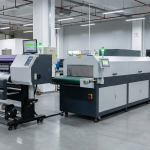
As businesses grow, manual DTF setups often become bottlenecks.
Industrial systems provide:
These improvements significantly enhance production stability and long-term profitability.
False. Many factories now operate multi-line DTF production setups.
Incorrect. Properly cured DTF prints pass:
With proper training and structured maintenance, DTF systems are manageable and predictable.
DTF printing is not a temporary trend. It represents a structural shift in textile decoration.
Future developments include:
As global demand for customization continues to grow, DTF will remain a core technology in digital textile printing.
DTF printing has grown rapidly because it solves real-world production challenges:
For businesses seeking a future-proof printing solution, DTF is no longer an alternative — it is becoming the standard.