📍 Contact Us
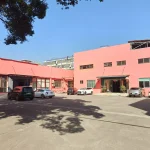
Factory Address:
Building 8, No.2-1, Nanyi Road,
Yongshan Village, Shiji Town,
Panyu Dist., Guangzhou, China.
Yongshan Village, Shiji Town,
Panyu Dist., Guangzhou, China.
Authored by: PrintVision Business Strategy Team
For decades, traditional screen printing has been the undisputed king of the custom apparel industry. It built empires on massive, high-volume orders. However, the global market in 2026 has fundamentally shifted. Today’s consumers and brands demand rapid turnaround times, complex full-color designs, and—most importantly—no minimum order quantities (MOQs).
For B2B print shops, trying to meet these modern demands with traditional screen printing often leads to razor-thin margins and exhausted staff. This is exactly why the industry is rapidly transitioning to Direct-to-Film (DTF) printing.
In this article, the PrintVision team breaks down the ROI and workflow comparison to show you why switching to a modern DTF setup is the smartest investment your print shop can make this year.
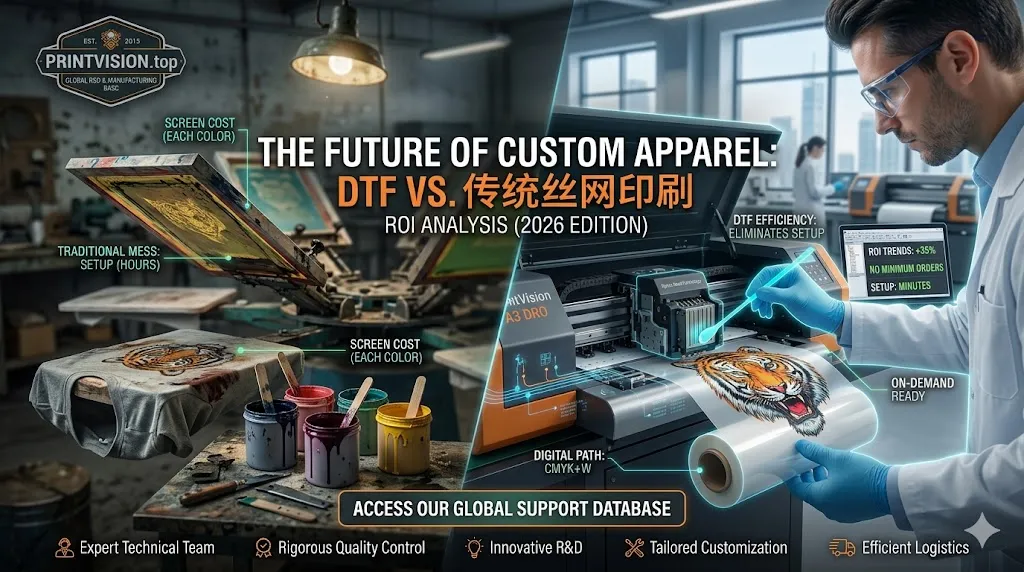
The Screen Printing Reality: Setting up a 5-color screen print job is a labor-intensive nightmare. It requires printing film positives, coating screens with emulsion, exposing them under UV light, washing them out, taping them, and aligning them on the press. This process can take hours before a single shirt is printed.
The DTF Advantage: DTF eliminates the entire prepress department. With equipment like the PrintVision A3 Desktop DTF Printer, the workflow is entirely digital. You simply load the PNG or TIFF file into your RIP software, click print, and the machine outputs a full-color transfer in minutes. By eliminating setup labor, you drastically increase your net profit per shirt.
The Screen Printing Reality: Because each color requires a separate screen and a separate setup, print shops are forced to charge customers “per color.” When a client brings in a beautiful, photorealistic gradient design, screen printers either have to turn the job down or use complex simulated process printing, which requires highly skilled operators.
The DTF Advantage: DTF technology utilizes advanced micro-piezo printheads (like the Epson XP600) to lay down CMYK and White ink simultaneously. Whether your customer wants a solid 1-color logo or a 100-color photographic portrait, the cost and effort remain exactly the same. You can finally say “Yes” to any design without punishing your clients with setup fees.
The Screen Printing Reality: Due to the immense setup time, it is financially impossible to screen print an order of just 5 or 10 shirts. Most shops enforce strict MOQs of 24 to 50 pieces, turning away highly profitable small businesses, e-commerce drop-shippers, and boutique brands.
The DTF Advantage: DTF is the king of micro-runs. Printing one shirt takes the same setup effort as printing one hundred. This agility allows you to tap into the booming “On-Demand” apparel market, charging premium retail prices for single-unit custom orders.
The Screen Printing Reality: A professional screen printing operation requires massive warehouse space for a multi-station carousel press, a 10-foot conveyor dryer, an exposure unit, and a washout booth with specialized plumbing for harsh chemical solvents.
The DTF Advantage: A complete, industrial-grade DTF production line—including the PrintVision A3 Printer and the 300mm Automatic Powder Return Shaker—can comfortably fit into a standard office room or a small workshop corner. Furthermore, the DTF process uses water-based pigment inks and requires zero chemical washout, making it an eco-friendly choice that complies with modern environmental regulations.
Screen printing will always have a place for massive, single-color runs of 5,000+ shirts. But for the 90% of custom apparel orders that fall between 1 and 500 pieces, DTF is vastly superior in speed, cost, and quality.
By upgrading to a PrintVision DTF ecosystem, you are not just buying a printer; you are buying back your time, expanding your catalog, and protecting your profit margins from rising labor costs.
Ready to calculate your exact ROI?
Visit www.printvision.top today to consult with our global sales engineers. Let us build a custom hardware package tailored to replace your outdated screen printing workflow.